

Robotic welding and advanced manufacturing
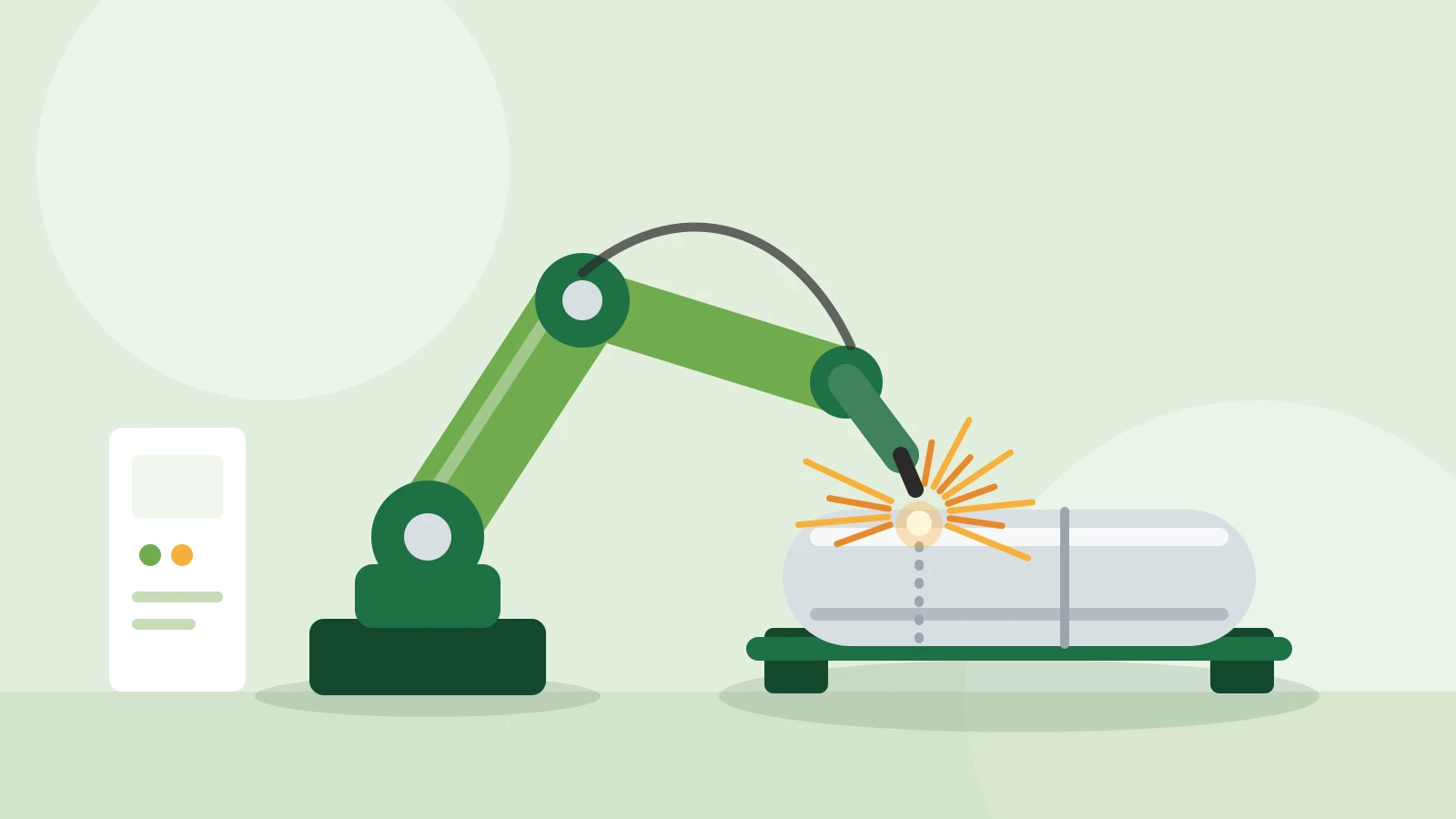
We’re investing in robotics and automation in our factory, starting with a robotic welder. Not for the sake of the machinery: so that every weld, on every vessel, is made the same way.
Investing in how we make things
A hot water cylinder or calorifier is a pressure vessel. Once it’s installed, it sits in an airing cupboard or plant room under pressure for years, and the welds that hold it together have to be right from the day it leaves our factory.
That’s why our investment in advanced manufacturing starts with welding. Our vessels are designed, welded and tested in our own factory in Dukinfield, under an ISO 9001:2015 quality system audited by BSI. Robotic welding adds something a quality system on its own can’t: the same weld, made the same way, every time.
What it means for you
Better welds, better vessels
Every weld made the same way
A programmed robot follows the same path, at the same speed and torch angle, with the same welding settings, every time. The weld doesn’t depend on who is on shift, how far into the shift they are, or which day of the week it is.1,2
Sound welds on a vessel that lives under pressure
A cylinder or calorifier sits in an airing cupboard or plant room under pressure, heating up and cooling down, for years. Its welds are where it has to be right. Consistent penetration and a consistent weld shape mean fewer places where a weakness could start.5,6,7
The hundredth vessel like the first
On a bulk or repeat order, the welds on the last vessel off the line are made to the same programme as the first. That matters when a contractor fits dozens of the same cylinder across a development, or a client orders a batch of identical calorifiers.1
Capacity you can plan around
A programmed weld cycle takes the same time each time it runs, which makes production easier to plan. Investing in automation is part of how we keep capacity up and lead times dependable.1
Robotics and automation
What we’ve invested in
- Recently installed
Robotic welder
We have recently installed a robotic welder in our factory, bringing programmed, repeatable welding to the vessels we make. It is the start of a wider investment in robotics and automation across our production.
In plain English
How robotic welding makes welds consistent
Each step in plain English, with a technical note for engineers and specifiers underneath.
1.What makes a good weld
A weld joins two pieces of steel by melting them together. To be sound, it has to melt far enough into both pieces and all the way through the joint where the design calls for it, with the right shape on the surface. Too little heat, or moving too fast, and the metal doesn’t fuse properly.
Technical note: Incomplete root penetration and lack of sidewall fusion are typically caused by too low an arc energy, too high a travel speed, an unsuitable torch angle or poor fit-up (root gap, root face, bevel angle).5,6
2.Why a hand weld can vary
In manual welding, a skilled welder controls the speed, the angle and the distance of the torch by hand and eye. Good welders are very good at it, but no one moves at exactly the same speed and angle on every seam, all day, every day.
Technical note: Arc energy is proportional to current × voltage ÷ travel speed, so a change in travel speed changes the heat put into the joint, and with it penetration and bead profile. Torch angle governs how well the arc reaches the joint sidewalls.4,6
3.What the robot changes
A robotic welder is programmed with the path, speed, angle and settings for a weld. Once the programme is proven, it repeats them the same way on every part, so the heat going into the joint, and the weld it makes, stays consistent.
Technical note: Automatic welding is defined as welding in which all the welding parameters are controlled, with no manual adjustment during welding; robotic welding is automatic welding by a robot that can be programmed for different paths and geometries. TWI notes the benefit as highly repeatable, high quality welds.1,2
4.Why the weld’s shape matters
Where the weld meets the plate, its shape affects how stress builds up there. A smooth, consistent profile along the whole seam avoids sudden changes that could become a weak point when the vessel is repeatedly heated, cooled and pressurised.
Technical note: The stress concentration factor at the weld toe depends on the weld geometry, including the toe radius and toe angle, and fatigue life assessments of welded joints are highly sensitive to it.7
5.What it doesn’t replace
A robot repeats what it is set up to do, so the quality still comes from the people: good joint preparation and fit-up before welding, a proven weld programme, and inspection and testing afterwards. Our vessels are still designed, welded and tested in our own factory, under our quality system.
Technical note: Robotic welding depends on getting the required joint shape and fit-up upstream, and on a defined way of verifying the finished joint.3
Lead times
Lead times for our standard range are live from our production system, the same figures shown on our product pages: the time to manufacture it ready for dispatch. Next-day delivery available on selected stock items, subject to availability; call for today’s lead time. For bespoke vessels, lead times vary by product – call 0161 343 8610 for today’s lead time on your product.
Planning an order?
Talk to us about your project
From a single replacement cylinder to a bulk order for a development or a batch of bespoke calorifiers, tell us what you need and we’ll price it.
Sources
- TWI (The Welding Institute), “What are the differences between mechanised, automated and robotic welding?” (definitions from BS 499-1) (opens in a new tab)
- TWI, Job Knowledge 135: Robotic arc welding (opens in a new tab)
- TWI, “Viewpoint: value and quality” (robotic welding) (opens in a new tab)
- TWI, “What is the difference between heat input and arc energy?” (opens in a new tab)
- TWI, Job Knowledge 40: Weld defects/imperfections: incomplete root fusion or penetration (opens in a new tab)
- TWI, “How can lack of fusion defects be prevented?” (opens in a new tab)
- K. L. Molski and P. Tarasiuk, “Stress concentration factors for butt-welded plates subjected to tensile, bending and shearing loads”, Materials 13(8), 1798, 2020 (open access) (opens in a new tab)
The sources explain robotic and automatic welding in general. What we say about our own equipment is limited to what we have installed.