

What makes a hot water cylinder right for a heat pump?
Not all cylinders are the same. The right one keeps your heat pump working properly and your bills down for years. Here’s what to look for, in plain English, and what to ask your installer.
Your hot water cylinder sits in a cupboard for 20 years or more. From the outside, most look much the same. Inside, they can be very different.
A heat pump works in a different way to a gas boiler. It needs a cylinder designed for it. Some cylinders on the market are built to a price, with a smaller coil or thinner insulation. You wouldn’t see the difference on the day it’s fitted. You’d see it in your bills, every year after.
The good news: there are just three things to check, and your installer can tell you all three.
Your bills
A well-matched cylinder lets your heat pump heat water cheaply. A poor one wastes energy every day, for as long as it’s there.
Your hot water
The right cylinder heats up quickly and stays hot. The wrong one can leave you waiting, or running short.
Your heat pump
Heat pumps are efficient when they can run gently. A cylinder that can’t take their heat makes them work harder.
Inside a cylinder
The three things that matter
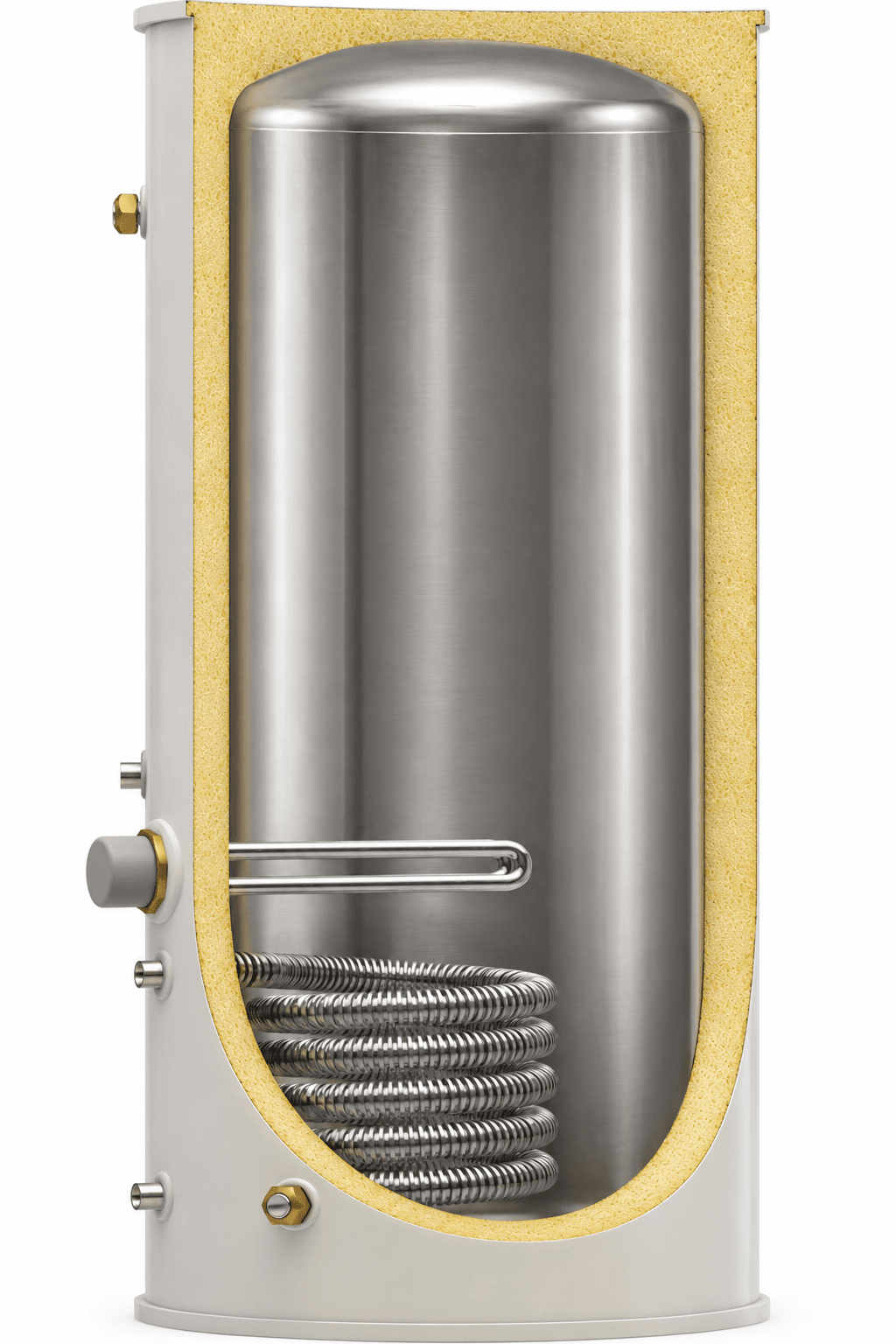
A cylinder is a tank of water wrapped in insulation. Water from your heat pump flows through a coiled pipe inside the tank and warms the water you use. Three things decide how well that works:
A bigger coil, because a heat pump’s water is cooler
A heat pump needs a much bigger coil than a boiler to heat the same water.
A gas boiler heats the water in its pipes to around 60 to 80 °C. A heat pump works best much cooler, around 35 to 55 °C. That’s what makes it efficient.
But the cylinder has to be heated with that cooler water. Think of warming your hands on a radiator: on a lukewarm one, you need a much bigger radiator to get as warm. The coil inside the cylinder is the same. With a heat pump, it needs a lot more surface to pass the same heat into your water.
A cylinder designed for a boiler isn’t good enough. If the coil is too small, your heat pump has to run hotter and less efficiently, your hot water takes longer, and the electric immersion heater may end up doing the work, which costs two to three times as much to run.
What to look for: a coil surface area matched to your heat pump. As a rough guide, about 0.25 m² for every kW. So an 8 kW heat pump needs a coil of over 2 m².
The detail, for anyone who wants the engineering+
Heat flows through the coil wall at a rate set by three things: how well the wall passes heat, its area, and the temperature difference across it (heat flow = U × A × ΔT). Cut the temperature difference and you have to add area to move the same heat.
Heating a cylinder to 50 °C with a boiler flow at 75 °C leaves a 25 °C difference at the end of the heat-up. With a heat pump flow at 55 °C, it’s about 5 °C. That’s why heat pump coils are so much bigger. Building Regulations (Approved Document L, 2021) already ask for new heating systems to work at a flow temperature of 55 °C or lower (what Part L says, and what changes in 2027).
An undersized coil means the heat pump has to raise its flow temperature to push its heat in. Each degree costs efficiency: measured heat pump data shows the efficiency falling by around 2% for every degree hotter it runs. The rest of the time, the heat pump cycles on and off, the reheat takes longer, or the immersion heater finishes the job.
Our coils, from our product data: our boiler cylinders (Stainless SuperFlow indirect) have a 1.1 m² coil; our Climacyl heat pump cylinders have 2.29 m² (90 to 180 litres) or 3.31 m² (210 to 300 litres). Our heat pump cylinder sizing tool uses a rule of about 0.25 m² of coil for every kW of heat pump output.
A wider coil pipe, because a heat pump moves more water
The pipe the coil is made from should be 28 mm, not 22 mm.
Because a heat pump sends out cooler water, it has to move a lot more of it to deliver the same heat. Often three or four times as much as a boiler.
Pushing all that water through a narrow pipe is like trying to drink a milkshake through a thin straw. The pump works harder, less water gets through, and the heat pump can’t work as well as it should.
What to look for: a 28 mm coil, or a coil your installer has checked against your heat pump’s flow rate.
The detail, for anyone who wants the engineering+
The flow a heat pump needs is its output divided by the temperature drop across the system: flow (litres a second) = kW ÷ (4.18 × temperature drop). An 8 kW heat pump at a 5 °C drop needs about 23 litres a minute. A boiler giving the same heat at a 20 °C drop needs about 6.
In standard copper tube, 22 mm pipe has a bore of about 20 mm and 28 mm pipe about 26 mm: roughly 70% more space for water. At 23 litres a minute, water moves at about 1.2 metres a second through 22 mm and about 0.7 through 28 mm. Resistance to flow rises steeply as the bore narrows: at the same flow, a length of 22 mm pipe has roughly three to four times the pressure drop of the same length of 28 mm.
Coil tube sizes vary between makers, and a small heat pump may be within its limits on a 22 mm coil. That’s why the question to ask is whether the coil has been checked against your heat pump’s flow rate. Our pre-plumbed heat pump cylinders have 28 mm primary pipework and components throughout, and their datasheets give the pressure drop (16 kPa at 17 litres a minute).
Thick insulation, to keep the heat in
Some cylinders on the market have as little as 25 mm of insulation. Look for 50 mm or more.
Insulation is the foam between the steel tank and the outer case. It keeps your water hot between heat-ups, so your heat pump doesn’t have to keep topping it up. Thin insulation means heat leaking into the cupboard all day and all night, and you pay for it.
You can see it for yourself
The immersion heater (the electric element that screws into the side of the cylinder) sits in a hole cut through the case and the foam. With it taken out, you can see the cut edge of the insulation and measure how thick it is.
This is a job for your installer, not a DIY one. An installed cylinder is full of hot water at mains pressure and the immersion heater is wired to the mains. The easiest time to check is before a new cylinder is fitted: ask your installer to show you.
What to look for: at least 50 mm of factory-injected foam, and a low heat loss figure on the datasheet.
The detail, for anyone who wants the engineering+
Heat leaks through foam insulation roughly in proportion to 1 ÷ its thickness. Halve the thickness and you roughly double the heat lost through it. On a 210 litre cylinder at heat pump temperatures, going from 50 mm to 25 mm of polyurethane foam adds something like 30 to 40 watts, all day, every day: around 300 kWh of heat a year. (An estimate for the foam alone; connections and fittings add their own losses.)
The Energy Saving Trust suggests adding an 80 mm jacket to a tank that has only 25 mm of foam, and estimates that saves around £45 a year. A cylinder’s standing heat loss (in kWh a day, or watts) and its energy label (ErP class) are on its datasheet. Compare them at the same size.
Ours, from our datasheets: 50 mm of factory-injected polyurethane foam, made with a CO₂ blowing agent. Every cylinder’s standing heat loss and ErP class is published on its datasheet.
What it costs you
Money you’d never see on a bill
A cylinder with thin insulation or a coil that doesn’t suit your heat pump wastes electricity every year: about £100 to £140 a year in our worked example below. There’s no bill that shows it. It just makes your heat pump look more expensive to run than it should be.
That’s an estimate, not a promise. The real figure for your home depends on:
- the size of the cylinder and how hot it’s kept
- how much hot water your household uses
- how well the coil matches your heat pump, and how often the immersion heater has to help
- where the cylinder is: in winter some of the lost heat warms your home, in summer it’s simply wasted
- what you pay for electricity
How we worked it out+
An example home with a 210 litre cylinder, over a year. Every figure is a round, indicative one:
- Hot water used: 2,200 kWh of heat (about 122 litres a day, the average the Energy Saving Trust measured in UK homes, heated from 10 °C to 50 °C).
- Heat lost from a well-insulated cylinder: 450 kWh.
- Extra heat lost through 25 mm of foam instead of 50 mm: about 300 kWh.
- Heat pump efficiency for hot water: 2.8 units of heat per unit of electricity with a well-matched coil; 2 to 2.2 with a coil that’s too small, as the heat pump runs hotter and the immersion heater helps out.
Well matched: 946 kWh of electricity. Poorly matched: 1,341 kWh to 1,475 kWh. At 26.32p a kWh (the Ofgem price cap (opens in a new tab) rate from 1 October 2026), the difference is about £100 to £140 a year.
Installers: our heat pump cylinder sizing tool picks the cylinder and checks the coil for a given heat pump. For commercial vessels, our insulation savings tool works out what better insulation would save.
Take this with you
What to ask your installer
Three questions. A good installer will be happy to answer them, and the cylinder’s datasheet should show all three.
- 1
What’s the coil surface area, and is it big enough for my heat pump?
A good answer: A coil sized for your heat pump. As a rule of thumb, about 0.25 m² for every kW, so over 2 m² for an 8 kW heat pump.
- 2
What size is the coil pipe (the bore)?
A good answer: 28 mm, or checked against your heat pump’s flow rate. A 22 mm coil can hold back the flow on a larger heat pump.
- 3
How thick is the insulation?
A good answer: At least 50 mm of factory-injected foam, with a low heat loss figure on the datasheet. Not 25 mm.
If you’d like a World Heat cylinder, just tell your installer or builder. They can order one from us direct or through a merchant.
Why World Heat
Built properly for heat pumps
We design and make our cylinders in Manchester. Here’s how ours measure up on the three things above, from our own product data.
Coils sized for heat pumps
Our Climacyl heat pump cylinders have 2.29 m² coils up to 180 litres and 3.31 m² coils from 210 to 300 litres: two to three times the 1.1 m² coil in our boiler cylinders.
28 mm pipework on our pre-plumbed cylinders
On our pre-plumbed heat pump cylinders, the primary pipework and components are 28 mm throughout, with the pressure drop published on the datasheet.
50 mm of injected foam insulation
Factory-injected polyurethane foam, 50 mm thick, made with a CO₂ blowing agent. Every cylinder’s heat loss and energy class is on its datasheet.
Stainless steel, built to last
Duplex stainless steel tanks, with a 25 year guarantee on stainless steel unvented cylinders up to 300 litres (subject to annual servicing). Made in our own factory under a BSI-audited ISO 9001 quality system.
Common questions
Can I keep my old boiler cylinder when I get a heat pump?+
Usually not. Cylinders made for boilers have much smaller coils, designed for water at 60 to 80 °C. With a heat pump’s cooler water, a small coil can’t pass enough heat, so the heat pump runs less efficiently and the cylinder takes longer to heat up. Your installer will normally fit a new cylinder made for heat pumps.
Is a bigger cylinder always better?+
No. Too big and you’re paying to keep water hot that you don’t use. The right size depends on how many people live in your home, your bathrooms and your heat pump. Your installer should size it; our sizing tool shows how.
Does a heat pump cylinder cost more?+
A well-made heat pump cylinder can cost more to buy than a basic one. But you’ll own it for many years, and a cylinder that wastes heat and electricity every year can soon cost more than the difference.
How do I get a World Heat cylinder?+
Ask your installer to fit one: they can buy from us direct or through a merchant. Or send us an enquiry and we’ll help you and your installer choose the right one.
Help choosing and specifying
Guides and tools
- Heat pump cylinder sizingWhich cylinder to fit for the home and the heat pump
- Pre-plumbed heat pump cylinder selectorThe package to suit your heat pump make and model
- Hot water storage sizing calculatorStorage volume and reheat time, homes and commercial
- Legionella and safe hot water storageHSE L8 and HSG274 temperatures for stored hot water
- Building regulations for cylinders and heat pumpsPart L, Part G and Part P, with the 2026 Part L dates
- Will it fit? Cylinder space checkerEvery cylinder that fits your cupboard or plant space
- Thermal store and buffer vessel stratificationDiffusers, baffles and keeping the layers apart
Need a cylinder built to your specification?
From 10 litres to 10,000 litres, our Manchester team designs, manufactures and tests every vessel in-house. We confirm and respond to every bespoke enquiry within 48 hours, and standard range enquiries immediately. If you need a price on a standard product, don’t hesitate to call and speak to one of our team on 0161 343 8610.We confirm and respond to every bespoke enquiry within 48 hours, and standard range enquiries immediately. If you need a price on a standard product, don’t hesitate to call and speak to one of our team on 0161 343 8610.We confirm and respond to every bespoke enquiry within 48 hours, and standard range enquiries immediately. If you need a price on a standard product, don’t hesitate to call and speak to one of our team on 0161 343 8610.
General guidance for homeowners. Figures marked as rough or typical are estimates and will vary from home to home; your installer should size and specify the cylinder for your heat pump and your home.